The Vagus Nerve Deception

Unmasking the phantom doctors and deceptive ads targeting the MCAS and PoTS community.
Reading time: 8 minutes | Too tired to read? Listen instead by hitting play above.
Mast Cell Activation Syndrome and Dysautonomia (typically in the form of PoTS) are frequently seen together.
I, like many people, have both. The combination of these two conditions ricocheting off one another means that, no matter how mentally cool, calm, and collected you are, your body never quite gets the memo and you end up physically stuck in fight or flight. It’s horrible. It’s exhausting.
The solution to this little conundrum, as Instagram reliably informs me, is to stimulate the vagus nerve, which can help calm an overactive sympathetic nervous system.
If your Instagram profile’s anything like mine, you’re already being bombarded with adverts for these strange, nerve-stimulating gadgets. Every other post seems to be of an annoyingly calm person with some strange bit of tech pressed to their chest or clamped to their head.
The problem, though, is that these devices can be seriously expensive — some with price tags north of £600 (Neuropod in the US retails for a whopping $900). How can you be sure if they’re actually any good?
Some kind of independent review would definitely come in handy.
Doctor, which device should I use?
A few days ago, Instagram served me an ad which linked to an independent review of the top five vagus nerve stimulators on HealthInsider.news. Great!
Not only was the article a rundown of the top five on the market, but it was published by a Doctor Alexandra Pierce MD. According to her bio, Dr Pierce graduated from Michigan Medical School in 2008, specialises in Obesity and Nutrition, sports massage, and post-operative rehabilitation, and has over 15 years of clinical experience helping patients improve their quality of life through evidence-based care.
This was exactly the type of in-depth, objective review of vagus nerve stimulators I was looking for.
But the review was — odd.
It tested five well-known devices: Pulsetto, Sensate, Nurosym, Truvaga, and Apollo Neuro.
Most “Top 5” articles build from worst to best, but after a little background on the vagus nerve, this particular article jumped straight to the best, declaring, “After careful consideration and thorough testing of various options, we confidently declare Pulsetto as the best overall choice for Vagus Nerve Stimulation”. Unusually ‘to the point’ for a comparison article.
Then there was the content itself. Considering the devices had been tested for five months, the information was surprisingly vague and skewed heavily towards the Pulsetto device. There was no mention of how the different devices were tested or by whom, which would have been helpful.
Was this just a dud article? Rushed perhaps - Doctors are seriously busy people after all. Or maybe Dr Pierce is simply a better doctor than writer.
The answer was a little more surprising.
Dr Alexandra Pierce doesn’t exist.
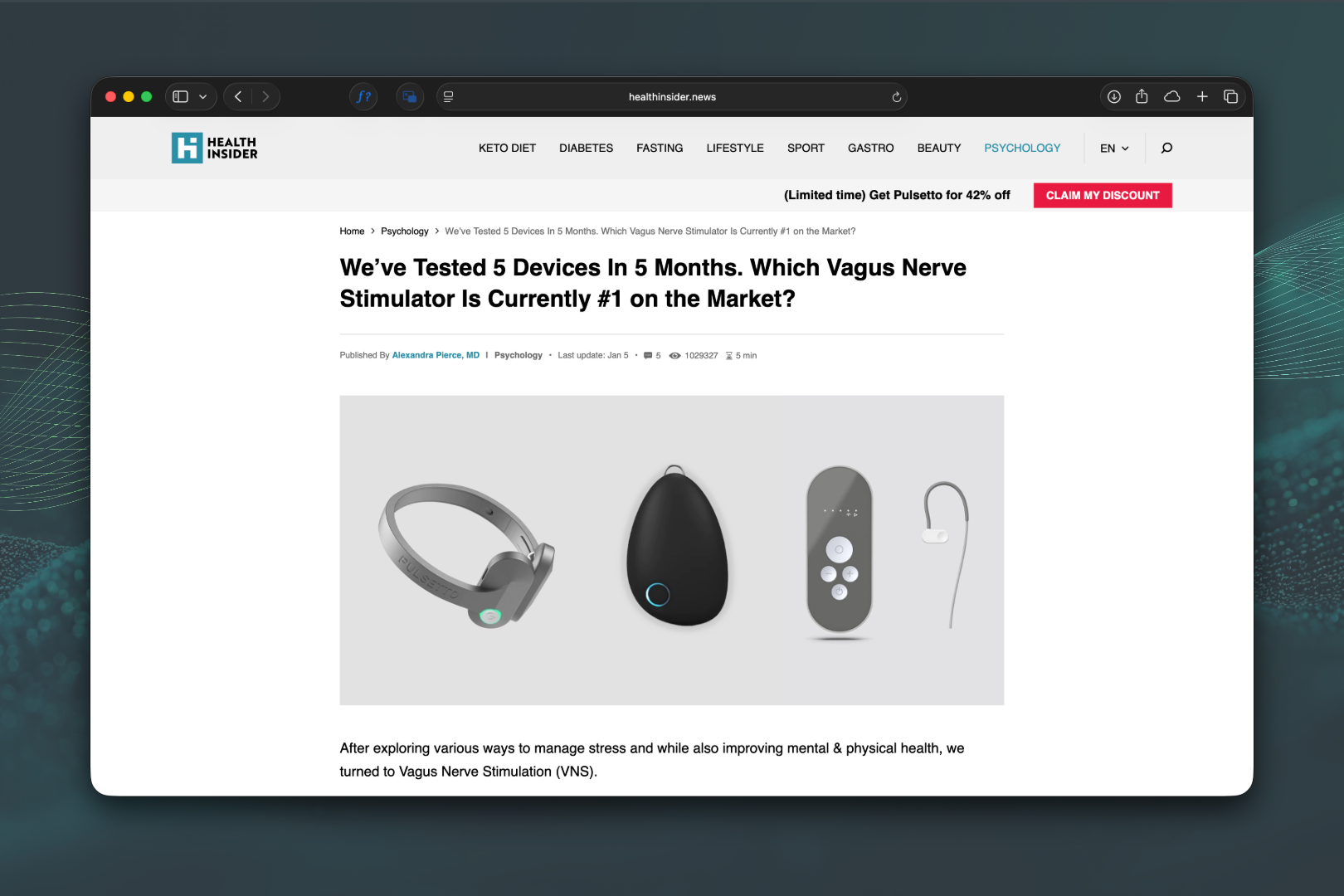
The article on Health Insider claimed to have independently tested five different vagus nerve stimulator devices.
Ai phantoms
Yes. You read that right. Dr Pierce isn’t real - she’s a completely fictitious persona. I’d been duped.
How do I know? Well, first, take a look at those medical specialisms. Obesity and Nutrition is typically a branch of Internal Medicine and Endocrinology. Sports massage and postoperative care, however, are entirely different career paths, and while not impossible, this particular combination of professional skills is pretty odd.
Then there’s those 15 years of clinical experience. You’d expect a doctor with well over a decade of experience to have some kind of online presence — a LinkedIn profile, a professional biography, or published academic papers, for example. Dr Pierce has no digital footprint beyond her work for Health Insider.
A search of the American Medical Association, State Medical Board, and NPI databases, which list practising US doctors, returned a handful of results for Alexandra Pierce, but none matched this particular Dr Pierce’s description nor graduated from the University of Michigan in 2008.
And the proverbial nail in Dr Pierce’s coffin? Her profile image looked a little suspect, so I ran it through an AI detection tool, which, while not foolproof, returned a 98% likelihood of it being artificially generated using a GPT-based image model.
Rest in pixels, Dr Alexandra Pierce.

Dr Alexandra Pierce has an impressive biography but isn’t all she seems.
Affiliate schemes and scheming affiliates
The article I’d landed on via Instagram is what’s known as an “advertorial” — paid-for content designed to mimic the format, tone, and authority of professional journalism. The objective: to part you from your money.
The practice, which feels decidedly dodgy, is legal in the UK and US but only when the content is clearly identified as advertising. Creating fake doctors and professional biographies which only serve to deceive people is most definitely not.
This particular advertorial didn’t provide any real insight into Vagus Nerve Stimulators as I’d hoped but did provide an unexpected glimpse into how the wearable medical device industry operates.
Many brands selling vagus nerve stimulators operate affiliate programs offering third-party sellers financial incentives to sell their products. There’s nothing wrong with this in principle; businesses need to make money, but when marketing campaigns aggressively target the chronically ill — it doesn’t sit so well.
Pulsetto, for example, while stating their goal is to “support 100 million people in starting each day with a greater sense of well-being and vitality”, also promises that if you join their affiliate programme, you can “turn your passion for health into profit”. Somewhat unashamedly, their website informs potential affiliates that they can also benefit from health influencers’ credibility, which “makes it easier to gain trust and interest from potential buyers”. Charming.
In order for affiliate schemes to work, a brand has to know a) which marketing campaign led to a sale and b) who that marketing campaign belonged to so the commission can be paid. In the case of dear Dr Pierce’s “article”, all the necessary tracking parameters are present in the URL.
These parameters would enable Pulsetto’s marketing team to see exactly which campaign and which publisher (Health Insider) is driving their sales every day. And considering they manually approve each affiliate partner, I personally find it hard to believe they’re unaware of phantom Dr Alexandra Pierce’s product recommendations.
And when it comes to dodgy practices, Pulsetto appears to have form.
While digging around for this article I also discovered Pulsetto has come under fire for deceptive tactics before. In December (2025) former professional sprinter and CrossFit athlete Michael Kummer and his editorial team discovered Pulsetto had deliberately rewritten text in a cited academic study to make it look as though they were involved in the research. They even replaced diagrams from the original study with images of their own Pulsetto device.
The middleman
Health Insider is what’s known as a “Performance Marketing” site and is designed to run adverts that look like credible news stories and professional journalism to lower the “barrier of scepticism” - and they pose distinct advantages to brands operating in the health and wellness sector, which is subject to strict regulation.
Affiliates using performance marketing sites act as a convenient middleman for brands wishing to employ more questionable methods to sell their wares while simultaneously keeping their hands clean.
If a doctor on a third-party site recommends a vagus nerve stimulator, the manufacturer gets the benefit of medical authority without the legal risk of making those claims on their own website. Claims of the device’s benefits can be exaggerated, and urgency tactics, limited-time offers, and curated testimonials can all be used to help hasten sales.
If the doctor is found to be fake or the sales tactics fall foul of regulations, the manufacturer can simply blame the rogue affiliate and deny any involvement. It’s a master lesson in plausible deniability.
While Pulsetto, Nurosym, Sensate, and Truvaga all operate affiliate programmes, I should point out that creating fictitious medical personas is a tactic used by some performance marketing publishers and isn’t necessarily happening across the board.

Remember, when you’re in an MCAS flare, your prefrontal cortex takes a hit. This is the part of the brain that handles executive functions like planning, focus, and decision-making. So, if you get that sudden “wow, this is the miracle I’ve been waiting for” - Stop! Take a moment as that emotional spike is exactly what the "Performance Marketers" are trying to trigger.
An argument for honesty
When you’re faced with a chronic condition like Dysautonomia/PoTS, MCAS, Fibromyalgia, or Chronic Fatigue Syndrome (ME), you’re so often and so readily disbelieved. Overlooked. It’s a lonely and isolating place to find yourself, and you inevitably seek not only help but visibility. You need to feel seen.
Companies like Pulsetto and many others that supply vagus nerve stimulators, symptom trackers, and wearables all claim to see the chronic illness community — to see our reality and our suffering — but to what end? With the rapidly growing medical wearables market estimated at USD $55.7 billion, it’s no stretch to see how a damaged nervous system can just as easily represent profit as it does suffering.
Like it or not, we in the chronic illness camp are the easy targets. The low-hanging fruit. Brain fog and fatigue routinely blunt our cognitive abilities — I, for one, am not always the sharpest knife in the drawer when I’m in an MCAS flare or my Dysautonomia’s been triggered. Companies like Pulsetto know this.
If they can’t reach us through advertorials, they’ll find another way. Worryingly, this is seemingly via influencers in the chronically ill community who may, themselves, have been deceived.
The chronic illness community has fought hard for recognition, research, and respect. We’re not conversion targets.
Calling these practices out isn’t an argument against wellness technology or the influencers who promote products that have genuinely worked for them. It’s an argument for honesty: that if a product works, it should be able to stand up to scrutiny without hiding behind a face that was never real. ◼
How to spot an Advertorial
01. // Look for signs of affiliation
Phrases like “we may earn a commission” or “this post contains affiliate links” mean the site earns money when you buy through their link. This doesn’t automatically make the review dishonest — but it means the writer has a direct financial interest in your purchase.
02. // Check the website’s URL
If you arrived at a suspicious site via a social media link or influencer video, check the URL of the website. If you see things like utm_source or campaign_id, you clicked on a paid-for advertisement.
03. // Check for fictional professionals
If a healthcare professional is quoted, Google them. Legitimate professionals will almost certainly have a digital footprint - LinkedIn profiles, clinic and hospital biographies, published research papers, etc.
04. // Look for urgency / scarcity tactics
Advertorials are designed to drive sales, and they want you to make a purchase quickly. Look out for phrases like “claim my discount”, “click here to check availability”, “sale ends in …” or “1,432 people are viewing this right now”, which are all designed to put the pressure on you.
05. // Check if it’s a Top 5 article
Top 5 lists are a common advertorial format. The giveaways that it might not be legit are lists that find fault with all but one product, so there’s only one clear winner, and lists which jump straight into the winning product’s specifics before examining all the others.
M.//
